Life ‘very hard’ for Sri Lanka fishermen in financial squall
By Uditha Jayasinghe and Devjyot Ghoshal
NEGOMBO, Sri Lanka (Reuters) – After three weeks at sea, Anton Fernando tallies his gross sales of tuna and different fish on a dock in Negombo, a fishing city in Sri Lanka, the place the nation’s monetary disaster darkens already murky waters.
The mathematics doesn’t look good for Fernando and his crew of 4 among the many dozen gently bobbing trawlers. Every takes dwelling 40,000 Sri Lankan rupees ($130) from their gruelling expedition.
“This is not going to be sufficient to cowl their family bills,” Fernando, 44, informed Reuters, holding up a pocket book scribbled with numbers. “Even earlier than we go dwelling, we all know this is not sufficient to cowl electrical energy and water payments, tuition charges and meals.”
The island nation of twenty-two million individuals off the southern tip of India is battling its worst monetary disaster since independence in 1948, as COVID-19, mismanaged authorities funds and ill-timed tax cuts sap dwindling overseas reserves.
Final week the central financial institution mentioned it was suspending reimbursement on a few of its overseas debt pending a restructure.
Within the business capital Colombo, protesters crowd the streets demanding the ouster of President Gotabaya Rajapaksa as individuals take care of skyrocketing costs, extended energy cuts and shortages of drugs, gasoline and different objects.
In Negombo, the fisherman battle to remain afloat.
Fishing makes up simply 1.3% of the Southeast Asian nation’s financial system, but it surely employs one-tenth of its individuals and helps feed way more. The island exports tuna, swordfish, crabs, lobsters and prawns to a dozen nations together with america, Britain, China and Japan, accounting for 8% of its agricultural exports.
Sri Lanka’s fisheries and finance ministries didn’t instantly reply to emailed requests for touch upon measures taken to assist the fishing business.
Some fishermen say they’ve in the reduction of on meals, others have stopped repaying loans. All of those that spoke to Reuters say they continuously scrounge for gasoline for his or her boats and their properties.
‘FOCUS IS TO LIVE TODAY’
In Negombo, a tight-knit fishing group 40 km (25 miles) from Colombo, employees pull fish from docked boats, weigh them and pile them right into a handful of refrigerated vehicles.
Every journey for Fernando’s vibrant St. Anne 2 trawler requires at the very least 1,000 litres (260 gallons) of diesel and several other hundred kilograms of ice.
“We have now to face in line for hours to get gasoline and even then we’re not certain if we are going to get sufficient. Ice, bait, nets, every thing we’d like has elevated in value,” he mentioned. “Many boats have stopped going out to sea solely due to the gasoline subject.”
Two fishermen with small boats mentioned they siphon petrol from pals’ and neighbours’ bikes as a result of gasoline stations refuse to fill their jerry cans.
Finance Minister Ali Sabry informed Reuters this month the federal government’s first precedence was to revive necessities corresponding to gasoline. He mentioned among the support the federal government is in search of from lenders just like the Worldwide Financial Fund would go to the nation’s economically susceptible populations.
“Fishermen do not understand how they’ll get gasoline or how they’ll handle excessive meals prices,” mentioned Herman Kumara, head of the Nationwide Fisheries Solidarity Motion that represents some 9,000 fisherman. “Their solely focus is to dwell in the present day.”
The disaster has grounded at the very least half the world’s trawler fleet, he mentioned, predicting “a life-and-death state of affairs right here over the following three to 6 months”.
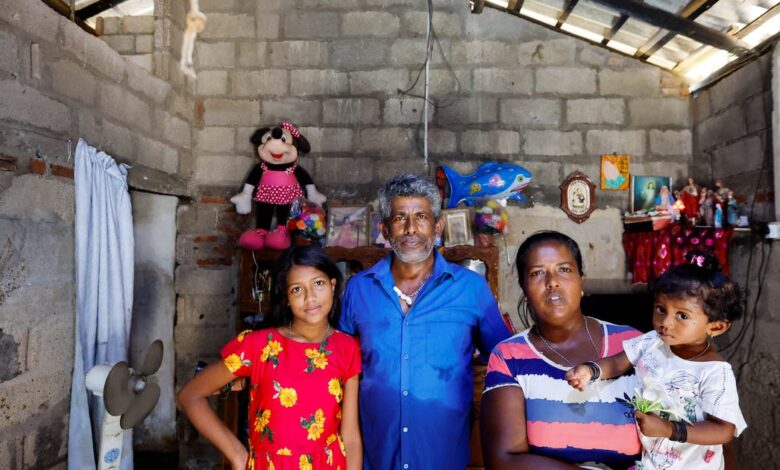
Mary Dilani mentioned she makes 1,500 rupees a day drying fish at a close-by seaside, whereas her husband G.Ok. Chaminda, who borrowed 100,000 rupees three years in the past for a small rowing boat and now struggles to repay the mortgage, makes 2,000 rupees.
“We can not afford cooking fuel anymore,” she mentioned of their small, two-room home by a plastic-strewn seaside in Negombo’s Sea Avenue neighbourhood, the place they dwell with their two daughters and granddaughter. “I’ve switched to a kerosene range however generally we can not discover kerosene.”
The household’s greatest fear is discovering 4,000 rupees for textbooks for a daughter about to start out the brand new college yr.
“Life has turn into very laborious,” Dilani mentioned.
($1 = 313.2800 Sri Lankan rupees)
(Reporting by Uditha Jayasinghe and Devjyot Ghoshal; Modifying by William Mallard)