Stocks, commodities slide as growth worries unnerve investors
By Anshuman Daga
SINGAPORE (Reuters) -Asian shares fell to their lowest in almost two years on Tuesday, as traders fretted concerning the poisonous cocktail of rising rates of interest and decrease financial progress.
Rising fears of recession and a slowdown in China dragged down commodity-linked currencies and oil costs, although security flows saved the greenback close to 20-year highs.
MSCI’s broadest index of Asia-Pacific shares ex-Japan tumbled as a lot as 2.3% to 515.7, sliding for a seventh straight session and increasing losses to 18% up to now this 12 months. The benchmark later pared losses to commerce down 1.3%.
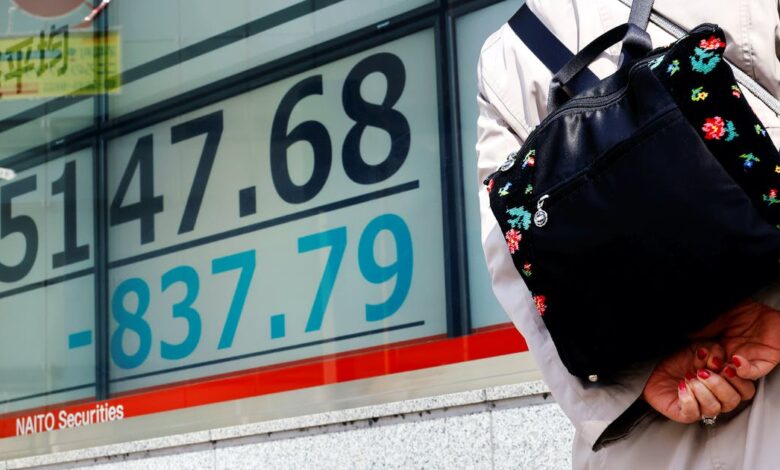
Throughout Asia, share indexes had been a sea of purple however traded above the day’s lows in risky markets. The Nikkei misplaced 0.9%, Australian shares shed 1.3%, Korean shares misplaced 1.2% and Taiwan equities had been down 0.3%.
“Chinese language progress is going through important headwinds, whether or not you have a look at official or non-public sector Buying Managers’ Index,” mentioned Music Seng Wun, an economist at CIMB Non-public Banking.
“Softening international progress is the persistent wall of fear for markets as traders look past the following 3-6 months. The view on progress momentum appears to be that revenge spending after the pandemic could also be affected by increased borrowing prices,” he mentioned.
MSCI’s Asian benchmark fell to the bottom since early July 2020. Chinese language equities are the worst performers amongst main markets up to now this 12 months, recording losses of between 21 and 25%. Singapore and Indonesian inventory indexes have, nonetheless, ticked up.
Development worries resurfaced after central banks in the USA, Britain and Australia raised rates of interest final week and traders girded for extra tightening as policymakers struggle hovering inflation.
Hong Kong’s benchmark share index returned from a one-day vacation sharply decrease on Tuesday and slumped greater than 4% earlier than almost halving losses.
On Monday, Shanghai and Beijing tightened COVID-19 curbs which have already taken a heavy toll on the world’s second-largest financial system.
China’s export progress slowed to its weakest in nearly two years, information confirmed, because the central financial institution pledged to step up help for the slowing financial system
U.S. inventory futures turned constructive after declining earlier. S&P 500 inventory futures rose 0.4%, Dow Jones futures ticked up 0.3% and Nasdaq futures gained 0.7%.
In a single day, U.S. shares prolonged Friday’s bruising sell-off as traders rushed to guard themselves towards the prospect of a weakening financial system. [.N]
“The concept of a benign and mild tightening cycle has evaporated,” ANZ analysts mentioned in a report.
“The truth is that the Fed can’t management the provision aspect of the financial system within the short-run, so so long as key indicators just like the labour pressure participation price keep low and Chinese language exports gradual, the chance to inflation, and subsequently rates of interest, lies to the upside,” ANZ mentioned.
Oil costs ticked decrease on demand worries as coronavirus lockdowns in China, the highest oil importer, continued.
Brent crude fell 1% to $104.75 a barrel and U.S. West Texas Intermediate crude additionally declined 1.1% to $101.96 a barrel, including to a 6% droop within the earlier session. Each contracts are nonetheless up about 35% up to now this 12 months.
Commodity-linked currencies together with the Australian and Canadian currencies took a beating as oil costs fell.
The Australian greenback dropped as little as $0.6920, its weakest since July 2020, having fallen 1.7% in a single day. Decrease oil costs additionally hit the Canadian greenback, which eased to C$1.3037 per greenback, its weakest since November 2020.
The greenback index was regular at 103.6, having risen as excessive as 104.19 in a single day, a contemporary 20-year peak.
U.S. Treasury yields, which have climbed sharply on expectations of aggressive tightening by the Federal Reserve, took a breather after Atlanta Fed President Raphael Bostic pushed again on ideas of an enormous 75 foundation level price hike on the Fed’s subsequent assembly.
(Reporting by Anshuman Daga; Further reporting by Alun John; Enhancing by Sam Holmes and Jacqueline Wong)