Toward an alternative future for Jewish art
WHO CARES ABOUT JEWISH ART, and the place does it belong? The class has lengthy confronted an issue whereby work is both too Jewish—too area of interest, too non secular, too rootless-cosmopolitan—or too secular, too queer, too political (typically code for too anti-Zionist). Jewish areas censor their very own; non-Jewish areas are afraid to have interaction. For artists, there’s typically a query of what language one has to talk to acquire funding: a query of whether or not one can present up as their entire self. In her 2019 essay “Kaddish for an Unborn Avant-Garde,” Maia Ipp requires a revitalization of the visionary in Jewish artwork, describing Jewish American philanthropy’s curiosity in sponsoring initiatives that assist ties to Israel and Holocaust remembrance to the exclusion of forward-thinking or dissenting Jewish cultural manufacturing. “Artwork within the Jewish group immediately is seen primarily as a device for training or didactic nostalgia,” Ipp writes. “A lot up to date Jewish artwork doesn’t problem; it pacifies [and] reinforces dominant, typically flawed, normative messages inside (and importantly outdoors) our group.”
But a sea change is underway, largely pushed by those that have identified the issue because it presently stands within the up to date panorama of Jewish artwork. Artist and filmmaker Danielle Durchslag has recognized a brand new inventive motion “blowing up and radically increasing the thought of Jewish allegiance.” As Rosza Daniel Lang/Levitsky has just lately written, “Jewish radicalism has at all times been a cultural venture as a lot as a political one.” However the intertwined tradition and politics of Jewish radicalism are thought-about marginal to “mainstream” Jewish life. Conversely, when cultural manufacturing in a radical Jewish custom makes its means outdoors of Jewish areas, its Jewishness is usually masked, illegible, or handled as incidental.
“I can’t rely,” Ipp writes in “Kaddish,” “what number of sensible younger Jewish artists and activists I do know who’re rigorously engaged with Jewish life who assume (rightly) that they’d by no means be given entry to mainstream Jewish skilled networks, fellowships, grants, or management roles.” Lately, artists have been organizing and increasing new grassroots sources of assist. For instance, the New Jewish Tradition Fellowship, directed and cofounded by Ipp (who was additionally on the crew that relaunched the leftist journal Jewish Currents), is open to candidates outdoors of New York for the primary time this yr. We are able to additionally look to “Years of Radical Dreaming,” which showcases radical Jewish artwork and tradition in a Hebrew calendar. That venture began in a lounge in Philadelphia in 5777/2016 (I drew the primary cowl and helped the founders pack orders that first yr) as a means of marking Jewish time with out resorting to 12 pages of Jerusalem skylines, whereas additionally paying artists who battle to seek out funding. Six calendars later, the organizers are growing a co-op mannequin to develop assist for Jewish tradition employees, notably queer and trans Jews, Jews of coloration, and Jews with anti-Zionist and far-left politics who’re estranged from typical patronage networks. Initiatives like these are excellent news for Jewish artists sitting uncomfortably within the areas between up to date artwork, dissident politics, and the mainstream Jewish group, and excellent news for a Jewish futurity the place assimilation and exclusion haven’t any quarter.

A number of latest exhibitions and a rising variety of different organizations point out a break from the survivalist and backward-looking fashions of conservative institutional Jewish initiatives which have lengthy narrowed public perceptions of Jewish tradition. There may be additionally, maybe, new house for the particularity of contemporary Jewish life in up to date artwork venues as exhibition makers start to take braver stances in conversations concerning the ethics of arts funding and their relationship to cultural boycotts and political violence. Liam Ze’ev O’Connor, one of many curators of “Havruta,” a gaggle present which opened at Chicago’s Heaven Gallery final October, desires to problem the customarily restricted in style understanding of what Jewish artwork will be: “Some folks need to say, ‘Properly, Jewish artwork is concerning the Holocaust, Jewish artwork is Judaica . . .” Yevgeniy Fiks, a cocurator of this yr’s first Yiddishland pavilion on the Venice Biennale, instructed me one thing related. “Fairly often, up to date Jewish artists are positioned in Jewish museums in Europe, subsequent to the Holocaust memorial, subsequent to websites of destruction of European Jewry,” he mentioned. “However what about different contexts for Jewish artists?” Yiddishland cocurator Maria Veits provides that Jewish artwork wants “a extra worldwide stage, a extra intersectional stage, and a extra up to date artwork stage.” The definition of “Jewish artwork” is expansive: It will possibly imply artwork by Jewish artists, artwork with Jewish themes, artwork created utilizing a Jewishly inflected methodology. For instance, “Havruta” takes its title from the standard method to Torah research and applies it as a technique for facilitating artmaking: Havruta is the act of studying with a companion, of forming that means by means of mutual textual discovery and dialogue (and the time-honored Jewish methodology of vigorous disagreement). O’Connor and cocurator Shterna Goldbloom chosen Jewish texts coping with the conception of time, pairing fourteen artists to create new work in dialogue with one another over a interval of about 9 months. Of their collaborative piece Tethered, 2021, Isabel Mattia’s sculpture, a glass vessel holding equal volumes of lamb’s blood and the artist’s breast milk, was offered alongside Hannah Altman’s images of Mattia on the sculptor’s farm. Altman’s sequence first reveals Mattia pregnant and ushering the farm’s lambs into the world, then culminates in an intimate portrait of the artist along with her personal baby. Altman known as the collaboration “lovely kismet”; Mattia describes it as “call-and-response.”

An expanded Jewish arts and curatorial observe depends upon bringing within the beforehand excluded and drawing on current, overlapping networks of those that have already been holding house for Jewish artwork. For instance, “Havruta” curator and artist Goldbloom, whose personal images provide a nuanced and deeply loving exploration of LGBTQ+ Hasidic and ultra-Orthodox Jews’ sophisticated relationship to spiritual group, additionally has work in “Yiddishland.” It’s tempting to play Jewish geography, straightforward to joke that each leftist Jewish tradition employee would after all know of one another. However as Lang/Levitsky writes, “There may be, actually, at all times extra on the market . . . we keep linked by sharing what we discover.” For instance, Goldbloom linked sculptor Val Schlosberg, whose work appeared in “Havruta,” to curator Liora Ostroff, who developed the 2021 present “A Fence Across the Torah: Security and Unsafety in Jewish Life” on the Jewish Museum of Maryland in Baltimore. Within the Chicago exhibition, Schlosberg’s clay vessels had been paired with hand-dyed and woven fabric and basketry items by Olive Stefanski. Their works staged a dialog about Pirkei Avot, a foundational textual content of Jewish ethics from which the Baltimore present takes its title: “Be affected person in [the administration of] justice, increase many disciples and make a fence across the Torah.” The concept of shared research reaches throughout the reveals. “I feel there’s additionally one thing profound about the way in which that each of those reveals are grappling with inherited textual content,” Schlosberg wrote to me. “My work is actually deeply formed by wrestling with methods to learn Torah as a residing textual content, looking for life and liberation and cocreate with inherited textual cultures.”
When cultural manufacturing in a radical Jewish custom makes its means outdoors of Jewish areas, its Jewishness is usually masked, illegible, or handled as incidental.
I grew up in Baltimore and was each stunned and delighted that “A Fence across the Torah” occurred the place it did. Till now, the Jewish Museum of Maryland has primarily hosted exhibitions about Jewish historical past, and is supported by The Related, a federation of Jewish companies that encompasses a lot of Maryland’s institutional Jewish life. The present is thrilling not solely as a result of it’s such a departure from what the museum has carried out previously however as a result of, regardless of Zionism being central to the mission of the Related, “A Fence Across the Torah” included explicitly anti-Zionist work and work by anti-Zionist artists. Schlosberg’s clay vessels, for instance, are exuberantly painted with references to Jewish mysticism and collective liberation; angels and biblical texts entwine with frolicking queers, burning cop vehicles, and Palestinian flags. Filmmaker Danielle Durchslag’s video collage Harmful Opinions, 2019, mines the 1988 movie Harmful Liaisons to create a satirical comedy a couple of rich Jewish heiress who’s socially shunned after she is overheard criticizing Israel. Durchslag instructed me, “I make passionately Jewish work [that] most Jews don’t like.”

The present additionally supported the creation of Disloyal, a improbable podcast, hosted by the JMM’s director of communications and content material, Mark Gunnery, which asks: “What does it imply to be loyal or disloyal, to a folks, to a state, to an thought, to an inventive observe, to a household, to a political dedication?” Ostroff’s curatorial assertion for “Fence” requires a recalibration in these commitments. “American Jewish communities and establishments should, on one hand, reply to rising antisemitism and white supremacist violence, and on the opposite, acknowledge the ways in which Jewish establishments have created bodily and emotional hazard for marginalized group members and neighbors marginalized by white supremacy and systemic oppression,” she writes. The museum hosted group talkbacks on questions of policing, security, and inclusion whereas growing the exhibition, which created each an outlet for attainable anxieties and a discussion board for the more and more intersectional and politically numerous face of Jewish life. This shift on the Jewish Museum is happening underneath the tenure of government director Sol Davis, who got here from the Jewish Historical past Museum and Holocaust Historical past Middle in Tucson, Arizona, in 2021. Pondering past the stewardship of objects, Davis sees his position as that of a facilitator who can flip the house over to completely different communities, reimagining the museum as a residing entity in and for Baltimore. Ostroff instructed me that no matter misgivings the museum board might have had concerning the present, they had been excited by its draw. “The board was like, ‘I’ve by no means seen so many younger folks right here!” Durchslag instructed me, laughing. “They had been so delighted and visibly thrilled that younger folks had been partaking and making work [about Jewish themes], and in addition discovered our work repugnant.”

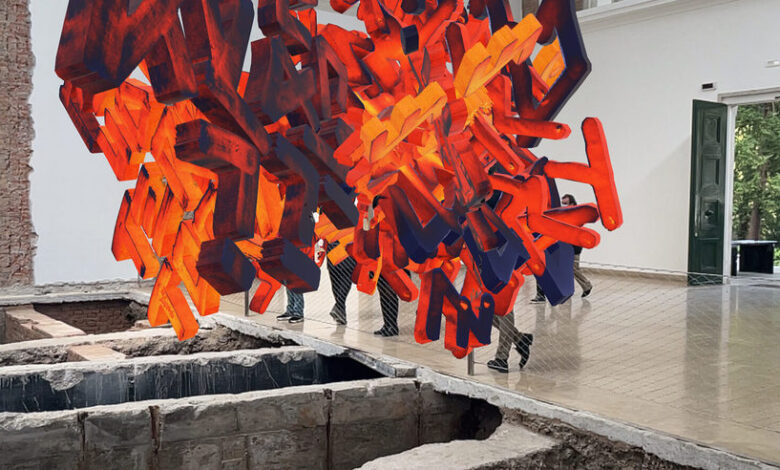
“Yiddishland,” at this yr’s Venice Biennale, is just not a bodily pavilion; like Yiddishland itself, it’s an imaginary place. It disperses itself throughout different nationwide pavilions, current without delay inside and past their borders. “I actually like that it doesn’t have its personal house,” mentioned cocurator Maria Veits, who conceives of “Yiddishland” as a transnational venture that provides a platform to Jewish artists with out figuring out them with any explicit nation, whereas on the similar time subverting the construction of the Biennale. For instance, the augmented actuality venture Pseudo-territory, 2022, by Ella Ponizovsky Bergelson and Anna Elena Torres, was accessible by way of QR code within the German pavilion; it represented each a hacking of the German pavilion and a dialog with its curators, if not a collaboration per se. While you scan the QR code, the article that seems is a roiling nebula of fire-toned symbols, Torres has beforehand known as “linguistic Cubism.” Drawing on a number of alphabets (Yiddish, English, and Proto-Canaanite) intertwined right into a maze-like sample, the repetition of the time period “pseudo-territory” in a number of languages requires the viewer to parse a number of angles concurrently. “An summary land is the proper place for imagining new sorts of desires and hopes for change inside Jewish communities,” Shterna Goldbloom mentioned of their participation within the pavilion. “Although I grew up in a Yiddish surroundings, I don’t communicate the language anymore, and have struggled to outline my relationship to a passive language of childhood. However understanding how so many different queers and anti-Zionists discover potential within the language makes me glad to seek out firm there.”
Zionism as a political motion argues that Israel is a venture of nationwide self-determination that may embody all Jewish life previous, current, and future—the negation of the diaspora (actually translated from שלילת הגלות) is a central tenet of Zionism. “Yiddishland,” against this, insists upon the importance and centrality of diasporism to Jewish historical past and futurity; the sweetness and risk of doykeit (the political precept of preventing for collective liberation throughout distinction in diaspora, which accurately interprets to “hereness”); the pluralism of Jewishness but in addition the prevailing influence of Jewish folks, tradition, and artwork on the websites of diaspora. “Yiddishland” is just not attempting to seize all the range of Jewish languages or methods of being, but it surely’s actually gesturing towards an expanded geography. Fiks describes it as “a spot shared by Jewish and non-Jewish folks; another map of Jap and central Europe.” (A “non-Jewish resident of Poland,” he explains, “can also be residing in Yiddishland.”) It charts new territory for belonging, the stress between universalism and particularity, the need for affinity and potential for solidarity outdoors of exclusionary constructions. Veits asks, “Is [Yiddishland] a community state? Is it a group state? Is it a state in any respect? Can it present another venture?”

“Yiddishland,” with its expansive ethical creativeness and nuanced questions on Jewish nationwide belonging, has garnered much less consideration than one would hope, notably from the artwork world and particularly in distinction to the concurrent controversy roiling Documenta 15, the 2022 iteration of the exhibition that takes place each 5 years in Kassel, Germany. The outcry has largely targeted on the depiction of antisemitic stereotypes in Individuals’s Justice, a 2002 work created by Indonesian collective Taring Padi in response to the 1965 genocide and fall of the Suharto regime in 1998 in Indonesia—however has unfolded right into a debate over the inclusion of Palestinian artists and solidarity politics, the German stance on BDS, and present-day relationship of Germany to antisemitism in an surroundings during which critique of Israel and assist for Palestine is more and more criminalized. The newest Documenta outrage considerations a caricature of an Israeli soldier being kneed by a lady; the portrayal belongs to a 1988 Algerian feminist brochure that was displayed in an explicitly archival setting by the Archives des Luttes des Femmes en Algérie. But in June, Germany’s high courtroom dominated {that a} plainly antisemitic thirteenth-century sculpture, known as the Judensau, can stay on public show in Wittenberg, as Germany displaces antisemitism as an exterior drawback, introduced into the nation by undesirable migrants and improper topics. As Berlin-based artist Virgil b/g Taylor instructed me, “there stays a disinterest in initiatives which might be truly revitalizing Jewish discourse and tradition in Europe in favor of a mandate to guard the imaginary pursuits of an summary Jewry that’s virtually solely conflated with Israel and the reminiscence of Germany’s murdered Jews.” In distinction, one would possibly search for path from the vibrancy of an lively, residing diasporic Jewish artwork world.
Artwork can’t open borders, abolish apartheid, or finish ethnonationalism and complicity with state violence. However it might contribute to the constructing of a counternarrative, to the development of a distinct path, a distinct place to show towards. On the Disloyal podcast, Liora Ostroff mentioned, “I feel that [“Fence”] reveals us how we will floor up to date artwork in Jewishness, and I additionally suppose Jewish artists have a singular set of instruments to problem dominant narratives in our communities and encourage change and transformation . . . Jewish establishments have largely ignored the ability of latest Jewish artists or been afraid of it as a result of artists have politics and artists will go off the cuff, however there isn’t a residing Jewish tradition with out the humanities.”
Solomon Brager is a cartoonist and author residing in Brooklyn. Their first ebook, Heavyweight (William Morrow), is forthcoming in 2023.