Immigration minister says he’s working on a faster path to permanence for temporary residents

Immigration Minister Sean Fraser says his authorities is getting ready to reinstate a program that will assist to hurry up the method of turning newcomers in Canada underneath short-term permits into everlasting residents.
“We’re wanting proper now at the very best path ahead to create a everlasting pathway for short-term residents,” he advised CBC’s The Home in an interview airing this weekend.
A earlier program referred to as the “short-term resident to everlasting resident pathway” — or TR to PR — was put in place final 12 months for eight months after COVID-19 lockdowns shut the border to newcomers to forestall the unfold of the virus.
It gave 90,000 important employees, front-line well being care employees and worldwide college students like Kushdeep Singh an accelerated path to everlasting standing.

Singh arrived in 2019 to check enterprise administration at Norquest School in Edmonton. The short-term TR to PR program was introduced simply as he was getting ready to jot down his remaining exams.
“Once I first got here to Canada I believed, ‘It is gonna take virtually about 4 years.’ Two years of my research then two years of ready for my PR utility,” he mentioned.
As a substitute, the approval got here by way of in lower than a 12 months.
“And I advised my mother. She was so, so blissful,” he mentioned. “I believe she was blissful as a result of I understand how arduous she additionally labored for me, like all my journey since I got here right here and … how she additionally sacrifices, like sending me away from her, in order that was a superb second.”
CBC Information: The Home20:04Vacation spot Canada
Migrants, specialists and Immigration Minister Sean Fraser speak about how this nation is dealing with the wants of immigrants and refugees coming to Canada.
Clock is ticking
Fraser mentioned the brand new program will not be similar to the outdated one. He mentioned he is working underneath a decent 120-day timeline established in a movement authorised by the Commons final month.
“That really places me on a clock to give you a framework to ascertain this new everlasting residency pathway, not only for worldwide college students, but additionally for short-term international employees,” he mentioned.
“We’re within the depths of planning the coverage so we will have a coverage that is not pushed by a necessity to reply urgently within the face of an emergency, however really to have a everlasting pathway that gives a transparent path for these looking for everlasting residency who can enter Canada.”
Rupa Banerjee is a Canada analysis chair specializing in immigration points at Toronto Metropolitan College. She mentioned persevering with to fast-track some individuals to everlasting resident standing is nice coverage.
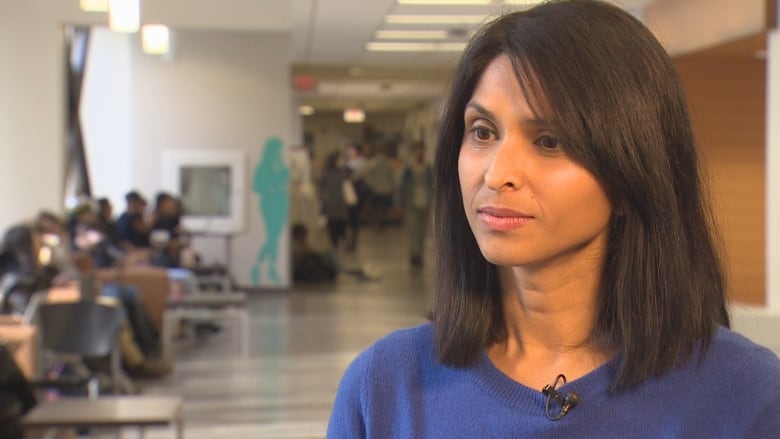
“Specializing in people who’re already within the nation, that was a necessary transfer on the time, after we had border closures and a number of the pandemic restrictions,” she mentioned throughout a separate panel dialogue on The Home.
“It additionally is basically useful as a result of we all know that those that have already got Canadian work expertise, Canadian training, they do are likely to fare higher as soon as they turn into everlasting residents relative to those that are available one step straight from overseas.”
The federal authorities set a objective of accepting 432,000 newcomers this 12 months alone. Fraser mentioned his division is forward of schedule, regardless of the pandemic and the surprising pressures of working to resettle hundreds of individuals fleeing battle in each Afghanistan and Ukraine.
“This week we really resettled the 200,000th everlasting resident, greater than a month and a half forward of any 12 months on report in Canada,” he mentioned. “We’re seeing comparable developments throughout different strains of enterprise like citizenship, like work permits, which in lots of cases are double the standard price of processing.”
Too many pathways?
Regardless of the upper numbers, considerations stay about processing backlogs and what Andrew Griffith — a former senior bureaucrat with Immigration, Refugees and Citizenship Canada — calls an excessively difficult immigration system with too many packages.
“There are simply so many pathways to immigrate to Canada. And I am not satisfied that anyone making use of to Canada — and even the individuals who attempt to handle this system — that they’ve a full grip when it comes to this system,” he mentioned. “So there’s an actual case, I believe, to be made for simplification.”
Griffith argued the variety of newcomers being accepted is much less essential than who’s coming to Canada — what expertise they carry and whether or not they can assist this nation enhance productiveness and financial development.
Banerjee agreed that the variety of newcomers is much less essential than who they’re and whether or not there are companies out there to assist them alter to life right here.
“The query is, can we really combine these people in order that they will actually contribute to the Canadian financial system and in addition to Canadian society, extra importantly?” he mentioned.
Fraser mentioned his division all the time units immigration and refugees targets with the supply of language coaching and different settlement helps in thoughts.
“This can be a very well thought out solution to set up immigration targets,” he mentioned. “However we all know we have to continue to grow the variety of people who find themselves coming to Canada to fill gaps within the labour drive and to, frankly, handle a really troubling demographic development with our growing older inhabitants if we’re going to have the ability to maintain companies that we rely on.”
And the pressures on the system proceed.

Canada signed on to U.S. President Joe Biden’s Declaration on Migration and Safety, launched on the Summit of the Americas on Friday. The settlement’s objective is to offer a authorized and safer means in for the hundreds fleeing gang warfare, corruption and poverty in Central and South America.
Underneath that settlement, Canada will proceed to just accept at the least 50,000 seasonal farm employees — a goal confirmed with Canadian employers — and to extend refugee resettlement from the Americas by welcoming as much as 4,000 people by 2028.
Which may not seem to be a giant change, however Fraser mentioned it must be measured in opposition to all the opposite methods individuals arrive in Canada.
“By world requirements, hundreds of refugees being resettled from a particular area and having that dedication for individuals is definitely a rare factor,” he mentioned.