Zack Hatfield on Andrew Wyeth’s Funeral Group drawings, ca. 1991–94


A golden rule: to go away an incomplete picture of oneself . . .
—E. M. Cioran
WHEN DO YOU STOP MOURNING a casualty of artwork? Some by no means do. Recall Dostoevsky, pushed to the verge of an epileptic assault by Holbein’s supine, open-eyed Christ, or the lads who, so moved by the excavated Laocoön and His Sons, started to writhe in imitation of the marble serpents and their prey. Right here now we have Oscar Wilde on a suicide in Balzac: “One of many biggest tragedies of my life is the loss of life of Lucien de Rubempré. It’s a grief from which I’ve by no means been ready utterly to rid myself. It haunts me in my moments of enjoyment. I bear in mind it after I chortle.”
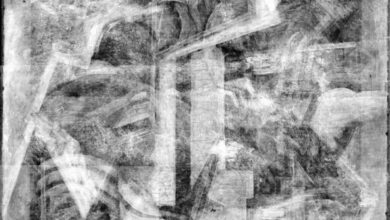
A lately found group of drawings made by Andrew Wyeth, the painter, attends in its personal technique to the overlapping of life, loss of life, and artwork. Lengthy derided as a regressive paragon of self-reliance and retardataire realism, Wyeth in actual fact frequently pursued a world outdoors of his physique, a world past embodiment itself. The dreary hills and overworked neighbors; the billowing curtain and haunted, changeless interiors—the afterlives of those pictures as family kitsch (on espresso tables, calendars, posters) belie a precision that’s clinging, paranoid, unreal. “I want I might paint with out me present,” he mentioned. His velleity finds its starkest expression in a physique of labor referred to as the Funeral Group drawings, ca. 1991–94, whose funeral is the artist’s personal. Futile to assign a motive to those long-forgotten memento mori, which may be thought of “completed” artworks however are possible deserted research for a full-size tempera. Andy, as his family and friends knew him, composed these drawings in personal and most popular to maintain them, if not strictly a secret, then mendacity in wait. (Not like Tom and Huck, he is not going to crash the ceremony to be lavished with a thousand materteral kisses.) Given the patent untimeliness of the Wyeth corpus, it appears solely becoming that its newest addition commingles the preliminary with the posthumous, bequeathing results with out causes.

His casket is surrounded by muses. Andy Bell, Anna Kuerner, Jimmy Lynch, Helga Testorf, Helen Sipala, Betsy Wyeth: the superstars of Chadds Ford, Pennsylvania. Arrayed in opposition to a clean floor save for infrequent fences, some outbuildings, the idea of a tree, the mourners bow their heads and shut their eyes, showing moderately corpselike themselves, particularly in particular person element research, the place every face takes on the serene hardness of a loss of life masks; our draftsman appears to know that his topics, his survivors, will likely be survived by their representations. Regardless of Wyeth’s near-unprecedented familiarity along with his sitters, he’s continually alert to the mysterious deserves of outsideness, to not point out the disorienting powers of verisimilitude, qualities underestimated by many practitioners of the revenant figurative model. Reasonably than unsettle the roles of painter and topic, Andy appears in these drawings to double down on his omniscience, locking himself contained in the one-way mirror of artwork and swallowing the skeleton key, holding Emerson’s clear eyeball as much as his personal lifeless “I.” My very own eye wanders throughout the varied sketches, from Helga’s braid to Betsy’s regular hand resting on the sting of her husband’s coffin, which accommodates a uncommon self-portrait, to a muddle of erasure marks. From the diagonals of phone cables (an anomaly in Wyeth nation) to the faint sloping line on the high that brings this funeral-cum–finissage into area: Kuerner’s Hill.

On October 19, 1945, a mail practice collided with a automotive stopped inexplicably on the tracks outdoors Karl and Anna Kuerner’s farm, immediately killing Andrew’s father (N. C. Wyeth) and three-year-old nephew, and spurring Andrew Wyeth’s profession into movement. A world with out heroes, with out God, a world that had begun to lose the plot: This could be his inheritance, elegy his project. The place N. C., a domineering father and thwarted wonderful artist, gained renown for his storybook illustrations of swashbucklers, cowboys, and Mohicans achieved within the rip-roaring Brandywine model, Andy would confine his existence and his easel to the purlieus of Chadds Ford and Cushing, Maine. Sly Homeric watercolors curdled into arcadias of mourning and melancholia; earlier than the Funeral Group, one can be hard-pressed to call a Wyeth depicting multiple particular person. His Snow Hill of 1989, a form of one-canvas retrospective, marks an exception: a wierd, Ozian fantasy of the hereafter set on the height of Kuerner’s Hill, the place six of his Chadds Ford fashions—all however two deceased by the point of the portray’s completion—cavort round a maypole topped with a Christmas tree, a white ribbon unclaimed, reserved for the artist himself.
Andy appears in these drawings to double down on his omniscience, locking himself contained in the one-way mirror of artwork and swallowing the skeleton key, holding Emerson’s clear eyeball as much as his personal lifeless “I.”

That the axis mundi of Wyeth’s Chadds Ford ought to represent such an oxymoron is telling. Like loss of life, his pictures activate the query of whether or not to go backward or ahead—and whether or not the selection is ours to make. The query confounds makes an attempt to recuperate the painter as a Trojan modernist, as does the space between his secular worldview and his dream, admitted solely by the work themselves, to entry the grace accessible to the believing masters. Trying on the funeral drawings, particularly within the portrait research, one is unprepared for the understanding of the artist’s line, its rememberedness, and the way it may reveal incompleteness to be the situation of immortality. Certainly, the one factor Andy favored greater than secrets and techniques had been revelations, of which probably the most regrettable, the so-called Helga Photos—a gaggle of 240 portraits, a lot of them nudes, of a German neighbor, covertly painted between 1970 and 1985 and finally flaunted to scandal by the Nationwide Gallery of Artwork in Washington, DC—dealt an nearly unrecoverable blow to his status and marriage. Within the funeral drawings, Helga stands on the head of the casket.

Within the 2014 e-book Rethinking Andrew Wyeth, curator Patricia Junker attracts a line from the Helga Photos to Étant donnés, the diorama secretly assembled by Marcel Duchamp between 1946 and 1966 and put in in 1969, a yr after the ostensibly retired artist’s loss of life, on the Philadelphia Museum of Artwork. What may Wyeth have thought as he pressed his eye in opposition to the peephole to seek out Duchamp’s assiduous, discomposing imaginative and prescient: a lifelike sculpture of a dead-seeming girl, bare and splayed amid the bramble close to a lake that may as properly be his beloved Brandywine River, solely thirty miles from the museum because the buzzard flies? Maybe he had heard the ur-Conceptualist’s well-known 1961 edict: “The nice artist of tomorrow will go underground.” Duchamp modeled the faceless physique of Étant donnés on his mistress Maria Martins and his spouse, Teeny (the topic of Christina’s World is likewise an amalgamation: of Wyeth’s middle-aged neighbor Anna Christina Olson and twenty-six-year-old Betsy). Writing in these pages, Helen Molesworth as soon as declared Étant donnés a metaphor for love, particularly the “shattering that’s just like the alienation from the self we encounter after we fall into the space-time continuum of affection and need.” Wyeth’s tableaux morts place witnesses at an analogous take away; the corpse, if it might discuss, may say that loss of life imitates artwork, or that they imitate one another, their shapes gleaned solely by way of vicarious expertise. Their vicariousness, when not triggering bouts of despair, offers us hope. And “the topic of the funeral footage,” because the artwork historian Alexander Nemerov writes, “is us.”

What do Andrew Wyeth’s funeral drawings, wreathed in lateness, have to supply “us”? As of this writing, the USA approaches a million pandemic deaths. The deep-rooted failures that led to this unforgivable landmark—failures that disproportionately afflict Black, Native, and Latinx folks, and which have disadvantaged 1000’s of a funeral—have additionally laid naked a politics of what Judith Butler phrases grievability. The declare to collective mourning is, as Butler notes, one thing feared way back to Plato, who sought to banish poets from the republic lest the inconsolable viewers of tragedies redirect their outrage at these in energy. Attuned to the transformative potentialities of shared grief, artwork historian Tanya Sheehan has invited acquaintances and strangers to assemble round Wyeth’s coffin at Maine’s Colby School Museum of Artwork, the place the exhibition “Andrew Wyeth: Life and Demise” will likely be on view by way of October 16. The disclosing of the Funeral Group will likely be accompanied by the work of latest artists together with Adrian Piper, George Tooker, Andy Warhol, and David Wojnarowicz, whose Untitled (Face in Grime), ca. 1990, photographed after his terminal HIV prognosis, is a remaining self-portrait of the artist, nearly utterly buried in a grave dug along with his personal palms. It’s unimaginable to consider these two males staging, at roughly the identical time, such completely different contemplations of mortality. The place Wojnarowicz imagines how grieving oneself may lead one to take care of the lives of others, Wyeth foreshadows how a life may be erased, and recovered, by way of the very act of wanting, by way of a physique of artwork. Who will uncover you, these drawings appear to ask, and can you be revealed?
Zack Hatfield is an affiliate editor of Artforum.