Expect more wildfires — in Europe and beyond — as society grapples with warming climate

The horrifying wildfires afflicting Europe throughout bouts of utmost warmth this summer time are a scourge the world will see extra of sooner or later, scientists say.
That raises questions on what will be finished to mitigate their impression as society grapples with the bigger challenges of attempting to restrict the warming of the planet. Although there are steps to be taken to stop hurt to people and habitat, the underside line is what we’re seeing in Europe might be a permanent problem.
“What we’re witnessing now’s a preview of the world we’re leaving to our youngsters,” Víctor Resco de Dios, a professor of forestry on the College of Lleida in Spain, advised CBC Information through e mail.
A bleak backdrop
There have been prior warnings that wildfires will develop into extra intense and happen extra usually in many years to return.
Latest stories from Europe — which has seen nearly 1,900 wildfires so far this year, nearly 4 occasions the common from 2006 to 2021 — illustrate the menace such fires already pose.
In southwestern France earlier this week, beachgoers in Arcachon lounged close to the Dune du Pilat, Europe’s tallest sand dune, as smoke from wildfires billowed into the sky. Hundreds had been pressured to go away close by campsites on quick discover.

Two wildfires within the wider Gironde area of France had been reportedly contained by Thursday, although officers mentioned they wouldn’t be fully extinguished for weeks.
In neighbouring Spain, the latest spate of wildfires have claimed lives of a firefighter and a sheep farmer. Fires there have pressured hundreds to flee, although some have since returned home.
In Britain, London Mayor Sadiq Khan mentioned on Tuesday the town’s firefighters had faced their busiest day since the Second World War, because of fires that broke out through the record-breaking warmth wave.

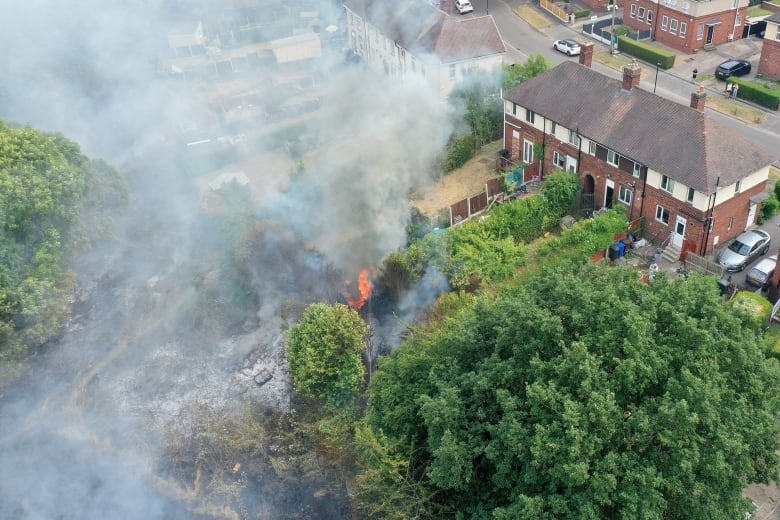
A Forest hearth burns in Shirley Hills on the outskirts of South London as Britain declares a report for the very best temperature so far.
Excessive warmth, fierce fires
The recent climate is only one facet of why wildfires are plaguing Europe. Excessive winds and drought additionally assist propel fires by means of forests and to locations the place individuals are.
Friederike Otto, a senior lecturer in local weather science at Grantham Institute for Local weather Change at Imperial School London, told The Associated Press a few of these components are significantly acute in southern Europe the place summer time wildfires are successfully “the brand new norm.”
That is to not say the chance goes away because the seasons change.

“The hearth season is lengthening globally,” mentioned the College of Lleida’s Resco de Dios, pointing to latest fires which have struck Portugal in early July, forward of the brunt of its typical hearth season later in August.
Resco de Dios mentioned seasonal hearth danger relies upon so much on the climate and the way dry the panorama is. And that has implications for future wildfire dangers because the world sees extra frequent episodes of utmost climate.
“The longer the dry spells below local weather change, the sooner the fireplace season will begin and the longer period it would have,” he mentioned.

Lethal penalties
On continental Europe’s southwestern edge, Portugal has confronted gruelling temperatures alongside wildfires which have burned by means of tens of hundreds of hectares of land.
There has additionally been lack of life: A pilot was killed in a crash, while fighting a wildfire in the country’s north and an aged couple died whereas attempting to flee a wildfire in a car, according to Reuters.

“What is occurring in Portugal is tragic,” mentioned Susan Gardner, the director of the United Nations Atmosphere Programme (UNEP)’s ecosystems division.
And Portugal has beforehand seen the devastation such fires could cause, when dozens of individuals died in wildfires there in 2017.
Prevention efforts
Within the wake of these lethal fires, Portugal applied a extra complete method to fireside administration in a bid to stop hurt and lack of life, Gardner mentioned. This concerned more engagement at the local level, partially to assist handle the dangers of wildfires in rural areas.

The UNEP has called for governments to spend twice as much on prevention, planning and restoration for wildfire occasions as they do on direct response efforts.
“Then you definately’re truly decreasing the chance, you are decreasing the harm,” mentioned Gardner.
Resco de Dios sees a have to “take quick motion to curb the fireplace drawback” with a deal with the land itself.
“We should make a large-scale transformation of our landscapes in order that they develop into tailored to the long run local weather and hearth regimes,” he mentioned, noting this would come with efforts to take away extreme vegetation that may gasoline wildfires.
Going through the long run
Coping with extra intense wildfires could also be daunting, however scientists categorical optimism that we are able to make adjustments.
“This isn’t an act of God,” mentioned Otto, the local weather science lecturer. “That is, to a big diploma, our doing.” However, she mentioned, people have numerous energy to do one thing about it.
Otto mentioned issues we are able to do to adapt embody placing an finish to the burning of fossil fuels and educating individuals about local weather change.
Extra usually, Gardner is optimistic about rising public consciousness of the perils of local weather change, significantly amongst younger individuals — and thus the capability to push for wanted adjustments.
She says that yearly individuals develop into extra cognizant of “how the selections we make as people contribute to the massive image when it comes to the local weather future that we wish.”