Dala Nasser at V.O Curations
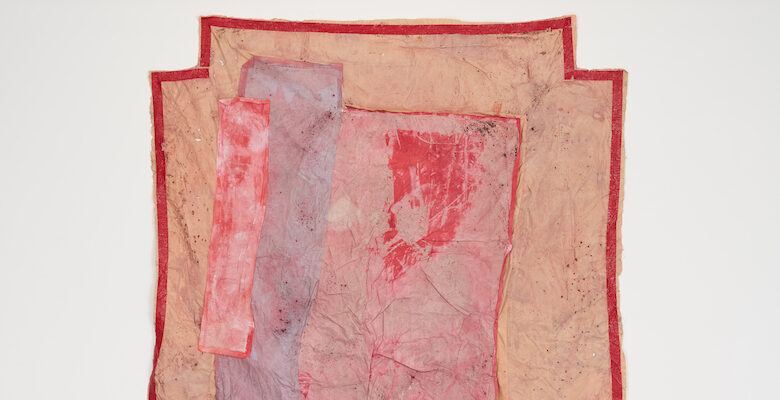
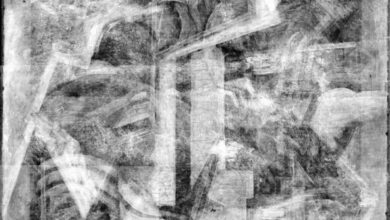
On first impression, Dala Nasser’s Hibiscus (all works 2022) is a reminder of the poverty of language when confronted with the complexities of shade. One might describe it as a sq. patchwork of pillowcases and bedsheets bordered with pink duct tape, its grey and brown cloth steeped with washes of pink and purple and flecked with white grit and sand. The generalizing vocabulary of shade, nonetheless, fails to seize what’s so particular in regards to the shades and tones archived on this work. The dye staining the sheets was constituted of hibiscus, rose, and anemone flowers rising on Nasser’s household farm in south Lebanon. The leaching of the dye was attributable to rain, which fell on the sheets once they had been left outdoors, over a number of months, on that very same land. Nasser’s colours are indexes of a spot: its flora, its climate.
In works like Oak, Zaytoun, and Flint Stone, scuffed marks are produced by charcoal rubbings. Others, like Anemone, are pockmarked with singed holes, the traces of ash and hearth. Indexes are generally considered merchandise of an instantaneous—the flash of a digicam, the autumn of a footstep—however Nasser’s newest works are merchandise of sluggish accretion. The steeping of dye and the rubbing of stones, the flowering of petals and gradual adjustments in local weather. They’re thus indexes of time, too, increasing what we are able to see, and what we are able to say, when care gathers the wonder, and violence, that’s layered on this and some other panorama.
— Kevin Brazil